Tinedale Animat Rubber Trial
Final Summary and Conclusions
Introduction:
Does rubber flooring have a positive impact on overall cow health? How does it affect reproduction, production and lameness? These are some of the questions we are attempting to answer through the evaluation of rubber mat flooring at Tinedale Farms in Northeast WI. The main objective is to evaluate how rubber flooring affects reproduction, behavior, production and cow longevity.
Materials & Methods:
Tinedale Farms is an 1800 cow commercial dairy with freestall facilities and double 21 parallel parlor. The freestall facility utilized for the trial has four pens in a tail to tail orientation (Diagram 1) Pre-trial observations on both cows and records were obtained on 12/23/02. Rubber mats were installed end of January 2003 with initial trial observations beginning 2/5/03. Mats were located in the parlor, holding area, transfer lane, and feed alleys of 2 pens. Cows in rubber pens (treatment) were assigned Animat = 2 and cows in concrete pens (control) were assigned Animat = 1. (All trial cows had access to rubber in the transfer lane, holding area and parlor). Individual cow locomotion and body condition scores were obtained every 3-5 weeks on all 4 trial pens. Heat Intensity was also noted as 1= intense chalk rub, 2= good chalk rub, and 3= marginal chalk rub. Individual cow reproduction and production data was gathered from Dairy Comp 305.
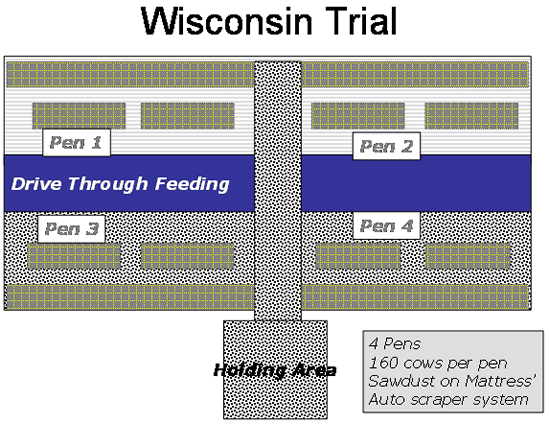
Diagram 1 Barn layout (Control pens 1 and 2)
Results & Discussion:
Reproduction
A 2 percent increase in pregnancy rate (PR) was measured for the Animat group during the 9 month period due to both heat detection rate (HDR) and conception rate (CR) improvements (appendix figures 2 and 3). Improved HDR as a result of more cows showing signs of estrus due to decreased levels of lameness (Research from the 2002 Proceedings of the 12th International Lameness Conference (p339-342) and 2001 J Am Vet Med Assoc (218: 1611-1614) showed improved reproductive performance of non-lame cows.) Heat intensity improved slightly in the Animat group as well as shown in appendix figure 1. Median days open (the point at which 50% of open animals become pregnant) improved in the Animat group by 18 days during the course of the trial (appendix figures 3-5).
Research by Dr. Overton of UC Davis shows a 1% increase in pregnancy rate is worth approximately $20 marginal income per cow per year (diagram 2). Assuming the 2% increase observed in this trial was realized in the entire 1800 herd, an estimated income of $72,000.00 would be realized after approximately 18 months. Alternatively, using DOPN value and assigning a conservative value of $2.00 per additional DOPN, the herd would realize an estimated $64,800.00 on additional income during the next 18 month period.
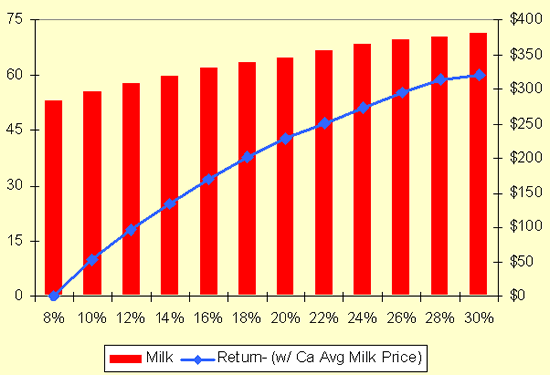
Diagram 2. Milk flow and return per cow (Dr. Michael Overton, UCD, 2003)
Locomotion Scoring and Body Condition
Locomotion and Body Condition (LS = locomotion score, BCS = body condition score)
TABLE 6: 60 day
Animat |
# of Cows |
Ave. Begin LS |
Ave. End LS |
Change in LS |
1 |
216 |
2.4 |
2.3 |
-.1 |
2 |
211 |
2.3 |
2.1 |
-.2 |
TABLE 8: 60 day
Animat |
# of Cows |
Ave. Begin BCS |
Ave. End BCS |
Change in BCS |
1 |
216 |
2.89 |
3.46 |
.57 |
2 |
211 |
2.94 |
3.50 |
.56 |
The above results show no difference in improvement for the overall average locomotion scores between Animat = 1 and Animat = 2. The 60 day summary showed a slight improvement in Animat = 2. BCS results were similar. (The first and last observations for each cow in the final data set was included in the average begin and end LS and BCS result, respectively.) The majority of cows’ standing time is in the holding area and parlor. Having rubber located in the holding area and parlor may have influenced the results as all cows on the trial were exposed to rubber flooring. Overall, rubber did appear to have a positive impact on locomotion scores. No real conclusions can be drawn on the effects of rubber flooring on body condition. The ration or nutrition of the dairy was not evaluated.
Production and Milk Quality
(ME305 = mature equiv. 305d milk yield, LGSCC = log somatic cell score)
TABLE 10: 60 day ME305 results
Animat |
# of Cows |
Ave. Begin ME305 |
Ave. End ME305 |
Change in ME305 |
1 |
209 |
23379 |
25513 |
2134 |
2 |
203 |
21286 |
23632 |
2346 |
TABLE 12: 60 day LGSCC results
Animat |
# of Cows |
Ave. Begin LGSCC |
Ave. End LGSCC |
Change in LGSCC |
1 |
209 |
2.8 |
3.2 |
0.4 |
2 |
203 |
2.1 |
3.4 |
1.3 |
53 cows with 0 IN LGSCC for Animat = 1
48 cows with 0 OUT LGSCC for Animat = 1
101 cows with 0 IN LGSCC for Animat = 2
34 cows with 0 OUT LGSCC for Animat = 2
Only data from cows with “IN” and “OUT” production records were used. Although production was lower for Animat = 2 cows, change or improvement was greater than Animat = 1 cows (shown in green on Table 10.) Similar to body condition, it is difficult to determine whether or not rubber flooring had a direct impact on production response without further, more in depth, analysis or modeling. Average DIM or stage of lactation change over the course of the trial could also have impacted average production results.
Turn times and Locomotion Trends
The chart below shows the turn times by pen. Pen 1 & 2 were Animat = 1 and pen 3 & 4 were Animat = 2. Pen 1 & 4 had the longest turn times, but they were also the largest pens. The dairy was on a 2.5 times a day milking schedule. Based on the observations below, time spent standing (turn time) was greater than the goal of 45 to 60 minutes. Installation of rubber in the holding area in this trial minimized time on concrete for all cows in the trial and may have negated other positive effects of the rubber treatment.
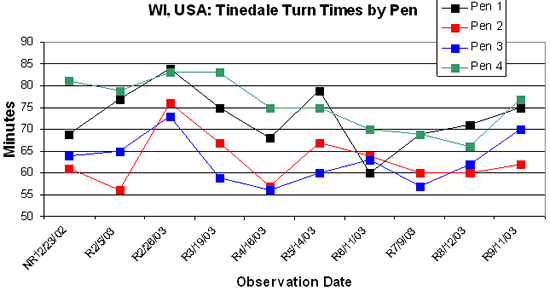
The following 2 charts show the trend over time of locomotion score observations:
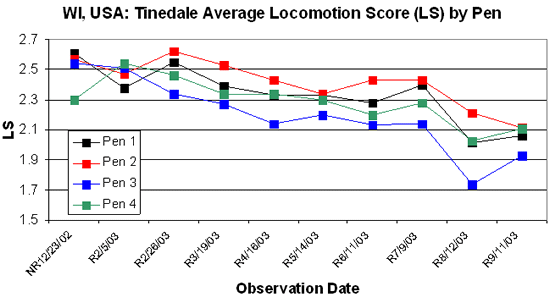
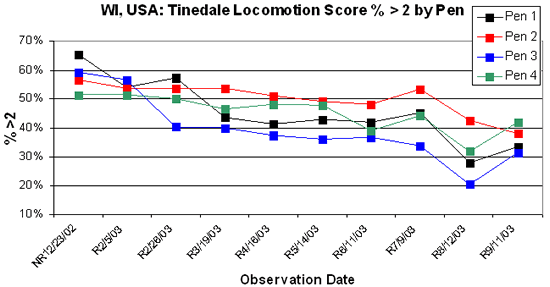
Locomotion scores in all pens decreased over the course of the trial with pen 3 remaining the lowest. Although the percent scoring greater than 2 (higher incidence of lameness) decreased, it remained well above the goal of having 10% or less scoring greater than 2. Research by P.H. Robinson, UC Davis shows a 5% milk loss with cows scoring 3, 17% loss with cows scoring 4, and 36% loss with cows scoring 5. A higher incidence of lameness is equal to milk lost in the tank. As discussed above (Table 6), rubber flooring appeared to improve locomotion scores and decrease lameness.
Conclusions
Installation of Animat rubber improved reproduction results compared to controls. These improvements will generate substantial additional income as a result of increased milk flow and decreased culling of open animals. The long term effects of improved hoof health cannot be determined by this short term study but would be expected to decrease losses due to lameness and culling of feet and leg problems.
No real conclusions could be drawn regarding rubber flooring effects on production, milk quality and body condition. Further in depth analysis is needed.
Overall, rubber flooring did appear to impact locomotion scores and decrease levels of lameness therefore creating a positive outcome on reproduction, locomotion, and potentially long term cow health and longevity.
APPENDIX
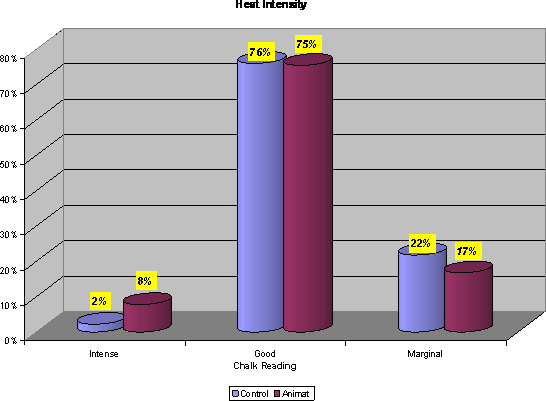
Figure 1 Heat Intensity
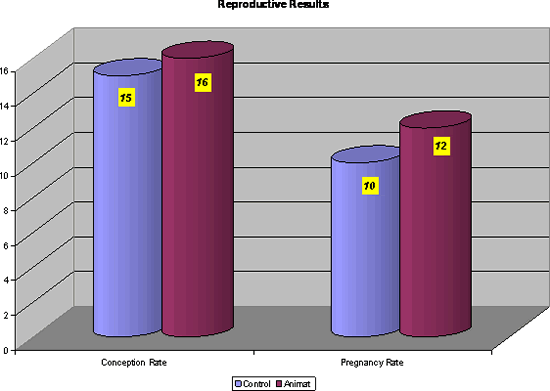
Figure 2. Conception and Pregnancy Rate comparisons
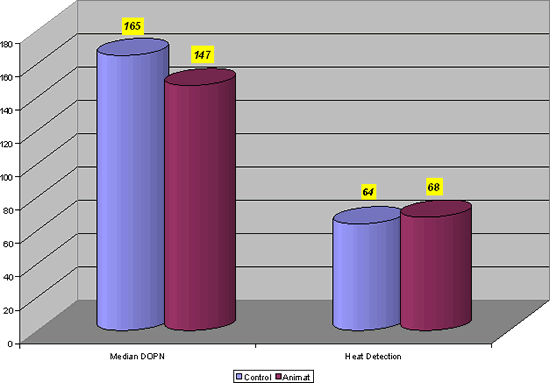
Figure 3. Median DOPN and HDR comparisons
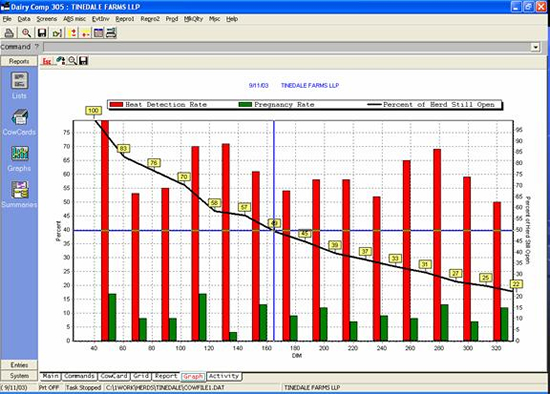
Figure 4. Control PR, HDR, and DOPN
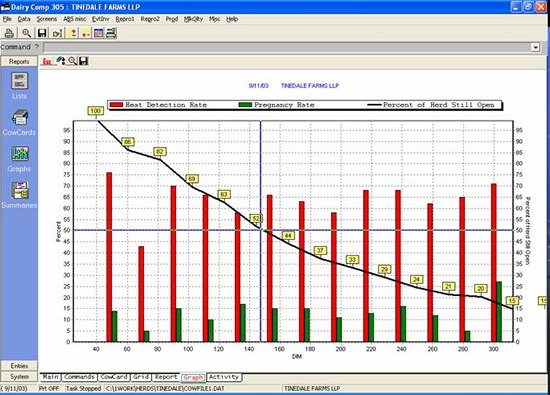
Figure 5.Animat PR, HDR, DOPN


